Showing posts with label patio. Show all posts

Dec 11, 2009

Cross-breed?

I blogged in my last post about pulling out the old leggy Zinnias and Marigolds from the flowerbed. For months I've tried sowing its seeds to grow, I think 4 or 5 batches - I couldn't remember now. Seedlings grew to a foot tall then they all dried up so easily - perhaps from over-watering?


I replaced these flowers with Pentas. And what-da-ya-know? Spotted this lovely bright orange Zinnia, taking up the backstage right corner. Now we've planted its parents in the front row so I was amused that this shy seedling preferred otherwise.

What a minute ... I was just flipping those the old blogs and couldn't find . I had Zinnias 'Yellow Flame' and 'Pink' planted in June. They grew above 3 feet tall and became leggy with smaller blooms. I find it hard to grow their seeds. In Nov, I bought dwarf-looking Orange narrowleaf zinnia (Zinnia angustifolia) to replace them. Dreadful rainy spell destroyed all before I could plant them into ground and snap photos.

Could this be a "cross-breed" ? Wow.


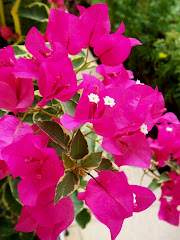
Sweet smelling 'Bunga Kerak Nasi' or 'Kesidang' (and many more other local names) before and after bloom. This pest-free flowering vine plant bloomed a few times in Nov and Dec. They enjoyed the rainy spell :)


Lovely bright yellows (Turnera) glows in the gloomy and wet mornings. It has spread out a lot since Sep. 


A cutie moth (to me, but hubby insist it's a butterfly, what do you think?)


Peace Lily (Spathiphyllum spp.). It does looked somewhat like an Anthurium in white. I love having Anthuriums, they look exotic like Orchids and blooms could stay on over a month. In fact I bought Pink anthuriums twice, tried in sunny and cooler locations, without much luck.

I'm told that Peace Lily requires filtered sunlight or else its leaves will burn easily.

Desert Rose's bud 2 weeks later (Adenium Obesum).

Oct 11, 2009

Kesidang's buds seem to be burned without blooming.

We relocated the thirsty and pouting tree beside our patio, the original position. We moved it thinking a sunnier spot will prevent Kesidang leaves to turn brown.
Pics of Kesidang leaf turning brown, here's 1st phase.

Starts to get tinge of brown in phase 2.

Uggh! Phase 3, the leaf falls off easily. One or two, perhaps I need to adjust to minimal watering. But everyday, we're get 2 or 3 brown leaves falling off at alarming rate. Gone are the lush green leaves we saw it at the nursery?
2 weeks ago, we moved the pot next to our porch for full sun from noon till 7pm. All leaves pouting by noon and for next 6 hours, dreadful looking. It has many buds, 30% of them seems to be burned brown and rest takes forever to swell to bloom.

Recently, we moved it back to the original spot today for 50% sunlight from 3pm till 6pm. Perky Kesidang leaves from morning then 6 hours later, unnoticeable pouting but looked agreeble - maybe today's cloudy weather? Will be monitoring for the next 2 weeks. Not to keen about plant on ground for now. It looks balance beside something vertical, i.e. porch, patio, wall, etc, so haven't decided which spot to plant on ground.

New leaves unfolds. Interesting indeed.
We're getting its wonderful fragrance, day and night. Buds bloom on differently days then fade, so it looks like a week long of  Water Jasmine (Wrightia Religiosa)'s fragrance.
Planned to start pruning and wiring when all flowers finished blooming.

Sep 25, 2009

Yellow brightens up

What's blooming beside the patio?

Yellow Alder (Turnera ulmifolia) blooms sporadically once from sunrise (about 6.30 am) until 3pm. If Yellow Alder is placed in full evening sun, then the bloom wilts earlier.

They are tropical hardy plants. I noticed they could survive afternoon till evening heat in full sun, 90+F. Leaves will droop as if to avoid the sun and to prevent further loss of moisture. After an hour or so from moderate watering, its leaves sprung up alive again. It didn't succumb to disease or pests and self seeds. When flower wilt and fall off leaving dried seed pod, so light its carried by wind. I would collect its seedling growing here and there in the garden, to replant next to Heliconia. I'm thinking orange-yellow-green mix on certain area of the garden.

Becareful not to over-water, leaves will yellow and drop off. In the begining, when its leaves droop had me worried and over-watered. This is our first pot, so you can see lots of missing leaves *grins*. I pruned a bit before Hari Raya - looks to me like a 'Ikebana'. Cute!


Davesgarden recommend this plant for xeriscaping.


A closeup on Yellow Alder's bloom; from afar it looked like a yellow hibicus, but a closer look one can see it doesn't have the staminal column with filamens at the end.


This bud will bloom tomorrow morning. Below 3 buds will bloom the next day. There will always be new buds everyday. Blooms bright yellow to keep my spirits up before leaving to work.


If you noticed, Yellow Alder pot swap places with Kesidang tree. We're experimenting if full sun will improve Kesidang tree. Its leaves turned yellow and drop off everyday had me worried. Looking for advice on Kesidang.

Sep 14, 2009

Fragrant Patio

We were looking for something to perfumate our patio. Preferably nature's scent as natural as it can be. Neighbours had wild orchids, ragoon creepers, indian jasmine, etc. So we're out seeking in Sg Buloh.

Nursery caretaker calls it 'Kesidang' or Vallaris Glabra or 'Bread Flower', Apocynaceae family. Impressive tropical vines that is very popular in Thailand and other South-East Asia countries. Mum-in-law fondly recalls it as 'Bunga Kerak Nasi' (more details below) . Both names applies, I was quite amused for a plant with 2 Malay names. Anyway, I found out that this special heavily scented plant was chosen 'state flower' of Melaka (located southwestern-central part of peninsular Malaysia). Kesidang a popular choice for decoration amongst the elite. Traditional Malay brides would decorate their hair with kesidang flower or used in ritual ceremonies. Kesidang symbolically represents the humble character and personality of the people of Melaka whom are friendly and courteous.


Left pic, poor plant underwent a hell ride in a Honda City. 5' tall and 15-inches wide - it's huge. Right pic, final touch up. The stems are small and flexible yet hard, consist a type of latex (white resin liquid) when cut.
In Peninsular Malaysia; the northerners would call it 'Pokok Bunga Kerak Nasi' (Rice Crust or Bread Flower). It is also called as 'Bunga Tikam Seladang' in East Coast. In the Western countries, it is known as the 'Bread Flower'. Plants believed to have originated from the islands of Java. Characterise by its longitunal woody and flexible stem like creepers. Commonly found on rooftops of pergolas, trellises in gardens, perimeter fencing or near windows; places to enjoy its fragrance. You can trim it to shaped into a hedge.
That's my foot, I couldn't carry it on my own. Tried dragging it to the side, ruining the grass in the process. I think it weighs more than me!
The size of its lush green leave, 6-inches. Looks like sirih. Broad leaves are known for its hardiness and high tolerance to drought, hot sun and high humdity. In other words, maintenance-free!
Requires adequate sunlight and watering for optimum flower production rate, and a good drainage.
It is easy to care and tolerates wide range of conditions. It can be trained as a compact bush and is good for container culture. Its sweet mildly fragrant like cut pandan leaves, travels 2 - 3 feet radius and it is very noticeable early in the morning. Some wrote that the scent is a cross between Jasmine and Pandan.
Moderate growth woody climber with pendulous of fragrant off-white, cup-like, 5-petals flowers inflorecences that grows from the branch near tip of a stem. In the middle, 5 white balls and a cone in the center. Buds take turns to bloom in each cluster. Blooming period could last 3 - 4 days. Attracts butterflies and hummingbirds. Here, tiny ants taking sip of its nectar.
Yikes yellow leaves! Nor's Paradise advised that Kesidang leaves will easily turn yellow and fall off if insufficient water.
A week later, more leaves (here and there) turned yellow and dropped. We moved it to a sunnier spot and I found we're not alone. Dr Abdul Ghani Hussain from Kedah (northern Peninsular Malaysia) wrote about his Kesidang fallen leaves and bare stem from neglect. A noticeable change when he moved it to a sunny side of the garden and some pampering, Kesidang fragrant blooms nonstop day and night. Fragrance is refreshing to some. His research on this plant extent to medicinal values. 
Will update you on our Kesidang progress ;-)

Sep 13, 2009

Busy Bee


Snapshots on a bee on Lantanas this morning.


As a child, was told to run away to avoid getting bee sting. On a instinct the moment I heard a buzzing-swish, I was about to flee. I stopped to think, this bee is after the nectar, not me. Standing still, trying my very best to catch a perfect shot (*sigh* need to upgrade this camera-la).


Little bee is spoilt for choice, so busy buzzing from one stem to the other. Couldn't care less about my presence. It seem to want to own the whole garden brimming with Lantanas' striking colours.


Other striking blooms; Gomphrena Globosa and Gerbera Daisy. Gerbera looks tired, sun-bleached, despite its stem and leaves healthy sheen of green.


Blue? Yes? Yes?
Yellow Alder (Turnera), self-sown in July outside of our perimeter wall. I brought it in, saved from grass-cutters. Matures 2 months later, now blooming beside Heliconia.

Pothos (mixed of variegated, deep green), you can say this "rojak" synonymous for mixed-up and messy. If uncontrolled will lead to what we'll call 'jungle-look'. For Chinese, we love healthy greens that symbolise money. Most leafy evergreen with sheen of green is favored for good fengshui. Pothos on southwest window sill while Episcia, northwest. Episcia grown from cuttings and replanted into the window-box late July, is catching up with Pothos that was planted in March. When it does, it'll be full of chilli red blooms!


Did some tidying up over the weekend. Garden needs some primping; anxious over the coming family renunion. This gathering coincides with a annual major festival celebrated by our muslim friends. It is a special occasion where muslim families reunite after fasting from dawn to dusk for 29 or 30 days (also known as 'Ramadan' month) is called 'Hari Raya Adilfitri' (Celebration Day of Fasting). Public holidays for 2 days. Therefore many, other races included, will take the opportunity to travel for a long vacation or out-station visitation.


Small planter boxes half-filled with blooms and greens. I combined into a bigger planted box, spread them in rows with spaces in between for better growth.

A good advice, to gently dig circling round the base of stem and avoid its roots, 2-inches deep then lift. Slowly disentangle twined roots with both hands. To reuse soil, stir to breakdown compacted soil and mix. Fill the new box with a thin layer of coco peat, with 2 inches deep of soil. Pressed to compact the soil then make an-inch deep hole to place the seedling. Top up with more soil in between after you are satisfied with the placement of all the seedlings. Pressed lightly to compact soil, this minimises air pockets where fungal disease thrive easily. Lastly, water.

Dec 18, 2008

You've got that "cheery" feeling


18 days since we brought from the nursery, thriving calibrochoa despite rainy season and approx. 4-6 hours of sunlight. I'm delighted receving its continuous blooms even after I had it divided into 3 pots. Its colours brings the kind of cheery feeling when strolling in the garden. It blooms better when facing west as compared to a pot-stand facing north.


From top: Northwest corner window-sill (1st & 2nd); Southwest corner window-sill.
Lastly, North-facing next to our main door. When faded bloom fell, leaves behind a black hollow dot in middle. Kind of cute, like a tiny-black-face on a green starfish! ;-)

*cheery feeling: bright and pleasant; "a cheery hello"; "a gay sunny room"; "a sunny smile" (wordnet.princeton.edu/perl/webwn) / showing or suggesting good spirits (thefreedictionary)


Update on 03/02/2009; This plant has not re-flowered since to my disapointment. Perhaps I need to relocate them for full sun throughout the day.


Place them in full sun, shade will severely limit the number of flowers. Superbells are self cleaning, you do not have to pinch off spent flowers. It can take the heat of hot southern summers making it a good replacement for petunias, and they can be perennial in zones 7 and warmer. www.shelbylandscaping.com/html/calibrochoa.html; http://www.naturehills.com/product/trailing_rose_superbells_calibrachoa.aspx

Nov 30, 2008

Calibrachoa (small petunia, million bells)


An exact beauty at Purple Ranch Lavender Farm, Texas (US) http://purpleranch.blogspot.com/2008/04/calibrachoa-at-purple-ranch-lavender.html.


Here's Jim McCausland on Calibrachoa, "This plant - like small petunias, and for years that's what many botanists thought they were. More recently Calibrachoa came to be recognized as a separate genus. This plant spreads and mounds like petunias, but its 1-inch-wide flowers resist the geranium (tobacco) budworms that chew petunias. Since Calibrachoa freely drops its faded flowers, you never have to deadhead. Treat Calibrachoa as a warm-season annual in Sunset climate zones 2–24. However, in mild-winter areas of California (zones 8, 9, 14–24), Calibrachoa can be grown as a perennial (it's hardy to about 23°). Million Bells, the first series on the market, comes in both trailing and mounding forms. The new Superbells series has slightly larger blooms in the blue, pink, red, and white range. For warm tones, look for the MiniFamous series." http://www.sunset.com/sunset/garden/article/0,20633,713304,00.html

Initially Calibrachoa (sometimes known as "Million Bells") are thought to be closely related to the petunia. However on further examination it has been found that there are major differences in chromosomes and breeding behaviour between Calibrachoa and petunias. The name Calibrachoa comes from Antonio de Caly Bracho, who was a Mexican professor of pharmacy (wikipedia).


It grows up to 6-12 in. (15-30 cm) and 1/2 the size of a petunia. Prefers Full Sun / Partial Shade. Blooms repeatedly. Its foliage are herbaceous and propagate through stem cuttings (plant does not set seed, flowers are sterile, or plants will not come true from seed) - patented cultivars unknown. Usually cuttings from firm stems with two leaf nodes (rooting hormone not required) stuck in regular potting mix, kept warm. Plant three to four cuttings per hanging basket, which will finish in 6-11 weeks. Calibrachoa will take 1-2 weeks longer than petunias.


Recommended to grow in hanging-baskets or where you can control the water saturation because it will flower less or dies when plants roots gets too wet all the time. Calibrachoa is considered to be relatively heavy feeders (200-300 ppm nitrogen); so be sure to keep plantings fertilized to prevent yellowing and lack of flowering. Most of the propagators suggest pinching the plants when they are transplanted, and then repeatedly pinching at 3- to 4-week intervals as needed. Once established it can handle heat and drought.


I bought this Calibrachoa in a plastic 6" hanging-pot from Bukit Rimau nursery today. Had it transplanted into 3 pots shown above. Hanging-pots doesn't appeal to me as you need to reach really high up for frequent light waterings, fertilizing and impossible task to check for pest. Calibrachoa in 2 baskets is placed at our single-window sills (outdoor facing West). While the one in a tall stand is placed next to our main door (North). Unlike the Old Fashioned Vining Petunia, it doesn't have any scent but it's vivid purple color will attract appreciating eyes when one passes by our porch. My fingers are crossed that mine will look as lush as Purple Ranch's and spreads like Jim McCausland's!

Oct 16, 2008

Patio: Being out in nature


Having a garden that stretches from the front to the back had us unleashed dreams of having a patio for alfresco entertaining, dining, working, etc - just overlooking our garden, our sanctuary, and connecting with nature.

A view of our terrace from patio, jade pothos (Epipremnum aureum) commonly known as 'money-plant' here. Easy-growing-maintenance plant, does well in our humid weather.
[Update May-1,'09] This spot had us the opportunity to capture Tailorbird and Sparrows on video. Do have an entertaining viewing at http://jaimeboey.blogspot.com/search/label/birds


These are my favs and its evergreen but it hardly flowers. Flame Violet (Epicias Kee Wee) http://www.logees.com/prodinfo.asp?number=T5080-2
Episcia - The "peacock plant" or "flame violet". These are the most beautiful of all gesneriads, known for their very colorful, textured foliage. Great under lights or in a warm window. Blooms in blue, pink, red, and yellow. A hint: you'll get more bloom by limiting the number of stolons the plant produces. http://www.robsviolet.com/episcia.htm
[Update Jun-13,'09] Great news, Episcia (mother-plant) has been flowering non-stop since Dec'09. Each bloom could last about 4 days, lipstick red and crispy leaves draws curious stares to touch. 4th propagating-batch started to bud & flower end May'09, all eye-catching on the window sill.


Have fun trying out our reflexology walk, sets for the beginner and amateur.

Stepping on these stones barefeet is almost like connecting to earth.
[Update Jun-13,'09] For beginners, tread the right path and left path for the advance (or the maschochist).
Blog Widget by LinkWithin